Chapter 06 — Security
Safe in a way you can feel, not a way you can see
Cameras, emergency stations, staffing, and lighting integrated into the architecture — reassuring rather than fortified.
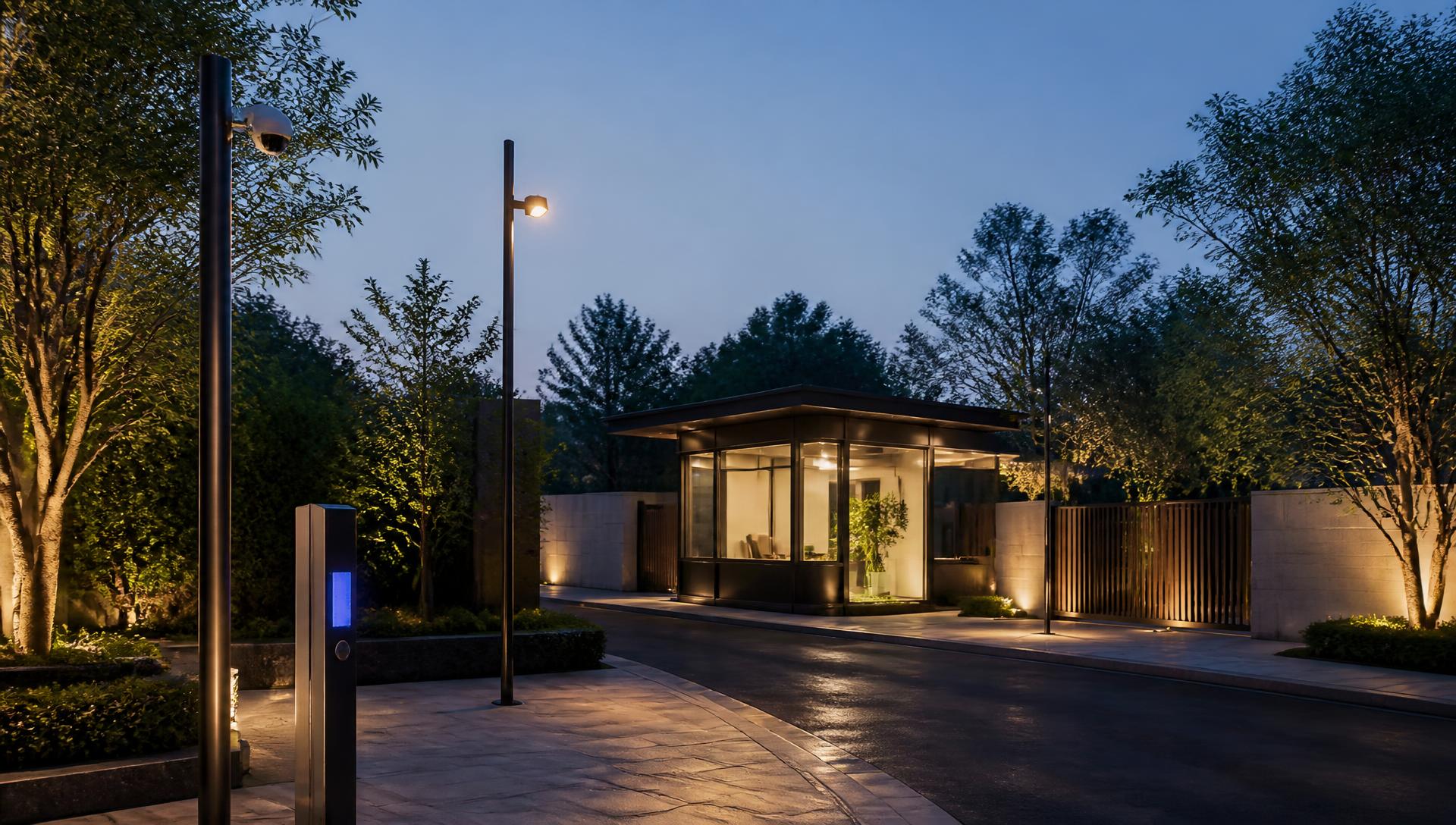
Security infrastructure and site office — conceptual rendering
Perceived safety is the single largest factor in whether a caregiver is willing to stop after dark. The design goal is a site where a person traveling alone at 10 p.m. feels comfortable getting out of the car.
That is achieved with light, sightlines, activity, and presence — with hardware supporting the environment rather than substituting for it.
Design intent
- Designed around perceived safety at 10 p.m., not just at noon
- Presence and light first; technology in support
- No dark pockets between parked vehicles
Elements
What this chapter is made of
Each element is a planning intent to be resolved through licensed design, engineering, and local review.
Camera coverage
Slim pole-mounted cameras with coverage across charging zones, the promenade, and the perimeter.
Emergency call stations
Clearly marked, illuminated call points at charging zones, the rideshare plaza, and the core.
Lighting strategy
Uniform, low-glare, pedestrian-scale illumination that eliminates dark pockets between parked vehicles.
Site office
A small staffed pavilion with visibility into the core — a person to walk toward, which no camera replaces.
Access control
Where implemented and legally permitted, controlled entry and plate-recognition options for gated or after-hours areas.
Natural surveillance
Active tenants, lit patios, and continuous sightlines so the site is watched by the people using it.
Security technologies, including any license-plate recognition or access control, would be implemented only where legally permitted and subject to applicable privacy law and posted policies.
Next step
Let's talk about the first hubs.
We are actively meeting with cities, utilities, landowners, charging networks, operators, and investors at the concept stage.